Employee Occupational Safety and Health

Happy Workplace

Apex is one big family, committed to creating a safe, fulfilling and mutually prosperous workplace. We regard our employees as our most important asset and give priority to the safety, career development and health and well-being of every member, with the goal of "zero occupational accidents." At the same time, we place importance on workplace human rights, environmental hygiene and labor-management relations, and use a range of measures to safeguard employees' physical and mental health, development opportunities and labor rights, so that every member of Apex can grow in a fair and safe environment.

Apex provides diverse and equal employment opportunities and ensures that all employees enjoy equal pay for equal work and labor-management relations built on mutual trust and respect. We strictly comply with laws and international initiatives to ensure that employees are not treated differently on the basis of gender, race, class, age or marital status. We have also established fair compensation and performance evaluation mechanisms and incorporated the Company's sustainable business objectives into the assessment, so that employees can develop their careers under fair conditions.

Apex has established the CEO BOX and BROTHER BOX, allowing employees to raise issues and suggestions directly with management. In 2025, Apex did not receive any significant complaints, reflecting harmonious labor-management relations with no major labor disputes. To further protect employee rights, we have established an Employee Welfare Committee to ensure employees' voices are heard, together with reasonable salary and performance evaluation mechanisms that promote fair development and effective incentives.

Employee safety and health are core to business operations. We have established a Safety and Occupational Committee that regularly inspects the working environment to ensure compliance and reduce workplace risks. Apex is also ISO 45001 certified, demonstrating its commitment to workplace safety.

To further safeguard employee health, we provide annual health check-ups so that employees can understand their own health status, and we promote a range of health enhancement programs to raise health awareness. We also provide occupational safety education and training so that employees can work in a safe environment and the incidence of occupational injuries is reduced.

Apex has always regarded shared social prosperity and corporate responsibility as its mission. We regularly hold charitable donation and charity sale events to care for disadvantaged groups, and actively take part in community welfare activities to promote the joint development of business and society. We believe that a company's success should advance together with society, and through these efforts we create a safe, fulfilling workplace with a strong sense of belonging while bringing a positive influence to society.

Personnel Structure

All employees are engaged under employment contracts with Apex, and there are no temporary workers, dispatched personnel or other non-employee workers. The employee numbers in the table below are based on the headcount as of December 31, 2025, and set out data on Apex employees' average years of service, average age and education levels. The total number of employees in 2025 was 7,605, of whom 4,327 were female, accounting for 56.9%.

Year202320242025
Number of employeesManager level and above142158171
Production departments3,5013,8643,248
General employees3,8724,2054,186
Total7,5158,2277,605
Employee gradeManager level and above1142158171
General employees7,0388,0697,605
GenderMale3,2473,5073,278
Female4,2684,7204,327
RegionTaiwan101011
China31739
Thailand7,5158,2007,555
Employee structureOver 50114141197
30–503,2033,4833,473
Under 305,9044,6033,935
Average age30.1030.1230.77
Average years of service4.003.944.44
Education distributionMaster's or above151715
College / university1,6871,9571,900
Senior high school3,1763,4933,107
Below senior high school2,6372,7602,583
Note 1: Employees at manager level and above — 2023: including 93 Thai nationals (65.49% of employees at manager level and above) and 41 female employees (28.87%); 2024: including 99 Thai nationals (62.66%) and 46 female employees (29.11%); 2025: including 99 Thai nationals (57.89%) and 47 female employees (27.49%).
Gender and Ethnicity Profile (%)
2025MaleFemaleTotal
ThaiChineseKoreanOtherThaiChineseKoreanOther
Manager and above0.790.590.140.090.510.080.01—2.22
Engineering3.910.470.04—1.840.22——6.48
R&D0.010.01——0.07———0.09
Information technology0.22——0.000.17———0.39
Other36.380.380.040.0153.690.29—0.0190.81
Total41.311.460.220.1156.280.590.010.01100.00
2024MaleFemaleTotal
ThaiChineseKoreanOtherThaiChineseKoreanOther
Manager and above0.730.470.100.100.470.09——1.96
Engineering3.460.26——1.460.07——5.25
R&D0.070.01——0.07———0.16
Information technology0.23———0.19———0.43
Other37.010.190.020.0154.710.24—0.0192.21
Total41.510.940.120.1156.910.40—0.01100
New Hires and Employee Turnover

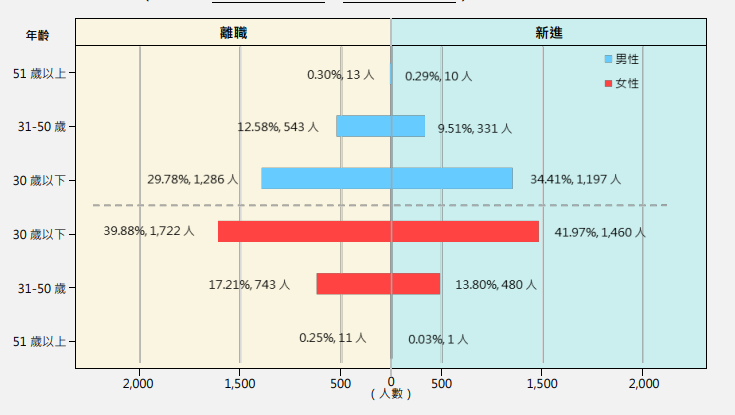
Apex's workforce is dominated by employees under the age of 30, most of whom are in the career exploration stage and are therefore the most mobile group, accounting for the majority of both new hires and departures. Employees aged 30 to 50 show relatively stable turnover and form the backbone of the Company. Apex continues to raise the retention rate of younger employees by enhancing training programs, strengthening career development planning, and ...improving compensation and benefit systems. The employee turnover rate for 2025 was 36.22%.

Note: Turnover rate = (resignations + layoffs and retirements) ÷ (headcount at period end + resignations + layoffs and retirements).
Employee Compensation Policy

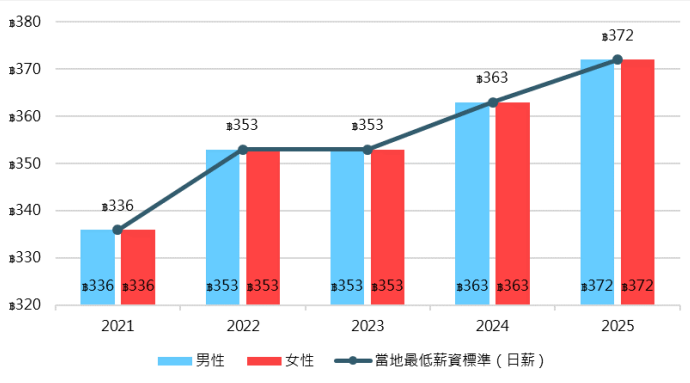
The Company provides a fair and market-competitive compensation system based on business performance and employee evaluation results, in order to attract, retain and motivate outstanding talent and to reward performance and long-term contribution. The Company is committed to providing stable compensation that supports employees' livelihoods together with a friendly working environment, thereby strengthening employee commitment and operational stability, and continues to implement sustainable development and corporate social responsibility, balancing environmental and social value and laying the foundation for long-term sustainable operation.

Note: The ratio of the standard entry-level wage to the local minimum wage is 1.00, the same for both male and female employees.

Guided by the principle of sharing results, the Company allocates no more than 2% of profits as employee remuneration, and conducts annual performance evaluations, using individual performance, level of responsibility and development potential as the basis for salary adjustments and bonus distribution. The compensation system is determined by employees' education and experience, professional competence, seniority and performance, and ensures that no differences arise on the basis of age, gender, race, religion, political position, marital status or union membership.

According to the Company's internal compensation statistics, the ratio of the annual total compensation of the highest-paid individual in the organization to the median annual total compensation of all other employees is 12.76. The ratio of the percentage increase in the annual total compensation of the highest-paid individual to the median percentage increase in the annual total compensation of all other employees is 18.20. The Company's organizational structure comprises a small number of senior positions and a large number of front-line employees; the differences above mainly reflect the level of job responsibility and the performance-linked design of the compensation system, and the Company will continue to review the fairness and reasonableness of its compensation structure.

Retirement System and Implementation

The Company's employee retirement systems are administered in accordance with the relevant laws and regulations of each place of operation, with pension liabilities recognized or contributions made in accordance with the law, so as to protect employees' retirement rights. The systems are as follows:

  1. Thailand: Under Section 118, Chapter 11 of the Thai Labour Protection Act, retirement benefits are provided to local employees. This is a defined benefit plan under which employees meeting the retirement conditions are entitled to a retirement payment equivalent to a specified number of days' salary based on their years of service. The related liability is recognized in the financial statements based on actuarial reports issued by qualified local actuaries.
  2. Taiwan: Employees in Taiwan are covered by the Labor Pension Act, under which 6% of monthly wages is contributed to individual pension accounts at the Bureau of Labor Insurance.

(Please refer to the Quarterly Financial Report — Note 14, Employee Benefits.)

Employee Training and Development Program

The Company places importance on talent cultivation and enhances employees' professional capabilities and workplace competitiveness through comprehensive education and training planning. Our training system covers new employee training, professional training, and continuing education for directors and managers, ensuring that employees obtain appropriate learning resources at every stage from onboarding through to promotion.

New employee training helps employees adapt quickly to the working environment, while professional training strengthens technical and management capabilities. Through mutual learning we seek to build employees' sense of belonging and a corporate culture of teamwork, and continuing education for management ensures that the decision-making level keeps pace with the times and leads the Company's steady development.

Item202320242025
New employee trainingMaleTraining hours (person-hours)45,57650,18434,080
Participants (person-times)17,09118,81912,780
FemaleTraining hours (person-hours)58,53667,53644,160
Participants (person-times)21,95125,32616,560
Professional trainingMaleTraining hours (person-hours)156,861102,593100,659
Participants (person-times)25,21016,67716,534
FemaleTraining hours (person-hours)196,602116,778118,453
Participants (person-times)32,13619,26619,875
Continuing education for directors and managersMaleTraining hours (person-hours)757890
Participants (person-times)222229
FemaleTraining hours (person-hours)394518
Participants (person-times)9103
TotalMaleTraining hours (person-hours)174,027152,855134,829
Participants (person-times)42,32335,51829,343
FemaleTraining hours (person-hours)255,177184,359162,631
Participants (person-times)54,09644,60236,438
Total training hours (person-hours)429,204337,214297,460
Total participants (person-times)96,41980,12065,781
Average training hours (hours)57.1140.9939.11
Employee Welfare Policy

The electronic components industry is labor-intensive, making labor-management relations an important issue that stakeholders also value highly. Apex's published labor-related regulations therefore all comply with international practice, including the Thai Labor Standards (TLS) and the Responsible Business Alliance (RBA) Code of Conduct, with the goal of zero labor complaints.

Apex treats all employees fairly and equally, and overtime is currently on a voluntary application basis. Based on each department's work objectives and competency requirements, the human resources department assists department heads in scheduling annual education and training plans, and clearly defines promotion assessment criteria for each job level to implement the goals of cultivating, retaining and deploying talent. Apex takes a comprehensive approach to employee compensation, benefits and communication, so that employees pursue not only personal achievement and development at the Company but also spiritual enrichment, achieving a balance between work and rest.

Compensation SystemBenefit MeasuresEmployee Care and Communication Channels
  • Employee remuneration
  • Long-service awards
  • Employee retirement systems administered in accordance with the laws of each host country
  • Multiple commuter shuttle bus routes
  • Employee uniforms
  • Staff canteen serving three meals a day
  • Full-attendance bonus
  • Sickness and funeral subsidies
  • Annual sports meeting and employee party
  • Parental leave and preferential treatment during pregnancy
  • Employee loans
  • Medical insurance for all employees
  • Employee Welfare Committee
  • Corporate website
  • CEO BOX
  • BROTHER BOX, etc.
Employee Organizations

Although Apex has not established a labor union, it safeguards employee rights through a range of employee organizations and formulates and implements the related regulations.

Labor-management relations at Apex are harmonious, with no major labor disputes. The Company values employee welfare and designs measures in response to environmental changes to meet employee needs. An Employee Welfare Committee has also been established to support employee benefits, encourage employees to express their views, advocate for reasonable working conditions and development opportunities, and safeguard employee health and well-being, achieving shared prosperity for both the Company and its employees.

Committee MembershipSafety and Occupational CommitteeISO 45001 CommitteeEmployee Welfare Committee
202320242025202320242025202320242025
APTAssistant manager and above556715723423014011115
Other personnel797660—2—272729
APSAssistant manager and above353——————
Other personnel16133———777
Total148153223234232140454545
Meeting frequencyMonthlyAnnuallyQuarterly


Human Rights Education and Training

Apex actively promotes human rights-related education and training aimed at raising employee awareness of corporate social responsibility and labor rights. RBA training emphasizes ethical business conduct and environmental standards, ensuring that the Company's operations comply with international norms, while TLS training focuses on compliance with Thai labor regulations, protecting employees' fundamental rights and promoting a positive working environment. Through these actions we demonstrate the Company's commitment to employees' physical and mental health, and take responsibility toward consumers through both product manufacturing and the treatment of our employees.

In 2025, internal human rights-related education and training at Apex totaled 1,338 person-hours.

CourseHoursMaleFemalePerson-hours
Responsible Business Alliance (RBA) Version 8.0 (2024)63749516
Internal Audit for Responsible Business Alliance (RBA) V8.061736318
TLS 8001:2020 Internal Audit and Requirements62262504
Total—761471,338
Employee Satisfaction Survey

Communication with employees is conducted through an employee satisfaction questionnaire, which is divided into four major categories: work and development, team and culture, human rights issues, and benefits and resources. The survey statistics closed on July 31, 2025.

Survey period2025
Survey populationAll employeesConducted byHuman Resources
Responses received3,940FrequencyOnce a year
Coverage52.65%1Overall satisfaction76.5%
Topics of concernQuality of life, working hours, salary and benefits, workplace discrimination
Improvement planContinue to optimize working hours and manpower allocation, regularly review salary and benefits, and further strengthen training on discrimination and the related grievance channels, so as to improve employees' quality of life, work experience and workplace environment.
Note 1: The total number of employees as of July 31, 2025 was 7,484.
Actions on Human Rights Issues
  • The completion rate for human rights-related courses among new employees during the year was 100%.
  • 298 awareness activities on human rights protection and the handling of related grievances were conducted through diverse channels.
  • Annual health check-ups are provided for employees; the completion rate for 2025 was 100%.
Human Rights Policy Commitment

To uphold and safeguard fundamental human rights, the Company recognizes and supports the ILO Declaration on Fundamental Principles and Rights at Work, the ILO Conventions, the ILO Tripartite Declaration of Principles concerning Multinational Enterprises and Social Policy, the OECD Guidelines for Multinational Enterprises, the United Nations Universal Declaration of Human Rights and the Ten Principles of the UN Global Compact, and complies with the labor regulations of the places in which it operates. On this basis the Company has established its Human Rights Policy Management Measures as the basis and code of action for promoting human rights protection. In practice, the Company continues to promote awareness of diverse human rights topics, covering key areas including the prevention of workplace bullying, mental health promotion, prevention of workplace discrimination, prevention of sexual harassment, and occupational safety and health. A total of 298 awareness activities were held during 2025; through training, internal announcements and diverse communication channels, the Company strengthens employees' understanding of and sensitivity to human rights issues and fosters a workplace culture of respect, diversity and inclusion. The Company has also established sound grievance and reporting mechanisms that provide employees with safe and confidential channels, ensuring that human rights issues are promptly disclosed and properly handled and are investigated and improved through institutionalized processes, so as to reduce risk and continuously refine management measures. Going forward, the Company will continue to deepen the implementation of its human rights policy, strengthen internal controls and training, and work to build a safe, healthy and dignified working environment, fulfilling its responsibility to respect and protect human rights.

Human Rights Management PolicyObjectiveSpecific MeasuresGrievance Channel
Providing a safe and healthy environmentImplement workplace safety and occupational disease prevention, providing employees with a safe, healthy and hygienic workplace.Care for employees' physical and mental health through safety and health programs, education and training, employee health check-ups and a range of health promotion activities.Employee Welfare Committee
Prohibition of child laborRefuse to employ any child labor under the age of 18.Recruitment is conducted in accordance with national regulations; only applicants aged 18 or above are accepted for any position, and applicants are verified during the application process to prevent omissions."Business Ethics Reporting Channel" on the corporate website, available to external parties for reporting or appeals
Prohibition of forced laborComply with the RBA freely chosen employment provisions and strictly observe local government labor laws and international standards to eliminate any forced or involuntary labor.Comply with local government labor laws; overtime required by work needs is on a voluntary application basis and may not be compelled in any form, with compensatory leave or overtime pay provided in accordance with the law."Business Ethics Reporting Channel" on the corporate website, available to external parties for reporting or appeals
Elimination of unlawful discriminationNo differential treatment or discrimination of any kind on the basis of race, class, language, ideology, religion, political affiliation, place of origin, place of birth, gender, sexual orientation, age, marital status, appearance, facial features, physical or mental disability, star sign, blood type or union membership, so as to protect employees' workplace human rights and provide a dignified and equal working environment.Established the Human Rights Policy Management Measures to protect employees' human rights and eliminate unlawful discrimination."Business Ethics Reporting Channel" on the corporate website, available to external parties for reporting or appeals
Promoting employees' physical and mental healthProvide appropriate and diverse activities to improve employees' work-life balance.The Welfare Committee organizes recreational activities for all employees at least once a year and holds monthly care activities for new colleagues, inviting department heads to take part so that team games and interaction strengthen employees' sense of belonging and cohesion.Welfare Committee
CEO BOX
BROTHER BOX
Harassment-free workplaceEnsure a working environment free from sexual harassment for all employees.Through awareness campaigns and public statements, employees understand their responsibility to help ensure that no workplace sexual harassment occurs in the course of their duties, and grievance channels, telephone numbers and mailboxes are disclosed to create a friendly working environment.CEO BOX
BROTHER BOX

Workplace Health and Safety

Apex places importance on workplace safety and health, providing medical rooms and first-aid personnel in each area, carrying out monthly inspections and replacement of equipment and personal protective equipment, and maintaining contact with local medical institutions to ensure that the most immediate assistance can be provided. In 2025, a total of 37 occupational injuries occurred across all plants, with no work-related fatalities. The main types of incidents were cuts, pinch injuries, foreign objects entering the eye, chemical splashes, collisions with objects and burns, with hands and eyes the most commonly affected areas. The causes were mostly related to equipment operation, contact with material edges, handling and unloading, and on-site work interfaces. The relevant departments will continue to reduce occupational injury risk and improve workplace safety performance through engineering improvements, hazard identification, education and training, PPE management and the optimization of work procedures.

To ensure sustainable operation, the Company has established an ISO 45001 Committee and a Safety and Occupational Committee responsible for supervising and implementing occupational safety management, ensuring that workplaces meet international standards and providing employees with a healthy and safe environment. Hazards are identified in accordance with the ISO 45001 Committee standard and risks are managed by classification. For work procedures that could lead to occupational accidents, operating guidelines are provided and employees' risk awareness is raised in order to lower the rate of occupational accidents. The Company has an Emergency Response Center with standardized response procedures, and holds annual disaster prevention drills to improve response capability and reduce losses.

In occupational health management, Apex provides annual health check-ups and promotes physical and mental health programs such as free massage services provided by visually impaired masseurs, smoking cessation campaigns and sports competitions, improving employee health and creating a friendly working environment. The Company has established high-risk operation controls, contractor management and safety standards, and monitors the working environment to reduce risk. Loss prevention and emergency response procedures are also well established, with regular drills to ensure employees' response capability.

The Safety and Occupational Committee focuses on continuous improvement. Its members are elected by employees, and monthly labor-management meetings are held to discuss safety and health issues. High-risk units and disaster types are treated as priorities, and training is strengthened to reduce the occurrence of incidents. Through these measures, Apex has built a sound safety mechanism, cultivated an internal safety culture, and ensured that employees develop in a healthy and safe environment, fulfilling its corporate social responsibility and supporting sustainable operation.

Safety and Health Indicator Statistics
IndicatorGender202320242025Unit
Occupational injuries1Male352827cases
Female101410cases
Total4542372cases
Occupational diseases3Male000cases
Female000cases
Lost days4Male393352626days
Female117246240days
Absentee days5Male38,90827,37424,841days
Female44,68033,69229,519days
Working hours6Male7,608,5038,301,3308,826,567hours
Female10,101,04711,150,14112,103,534hours
FatalitiesMale000persons
Female000persons
Note 1: Occupational injuries — all occupational injuries are included, including traffic accidents.
Note 2: All occurred at the Thailand plants; there were no occupational injuries in Taiwan, China or Singapore.
Note 3: Occupational diseases — diseases arising from work.
Note 4: Lost days — the number of days for which employees applied for occupational injury leave.
Note 5: Absentee days — total working days absent due to sick leave, personal leave and occupational injury leave, excluding annual leave, official leave, marriage leave, bereavement leave, maternity leave and paternity leave.
Note 6: Working hours — total scheduled working hours for each year; for daily-paid employees, the sum of total monthly working hours, and for monthly-paid employees, total working days per month × 8 hours × headcount at the end of that month.
IndicatorGenderPer 200,000 hours1
202320242025
Injury Rate (IR)2Male0.920.670.61
Female0.200.250.17
Occupational Disease Rate (ODR)3Male———
Female———
Lost Day Rate (LDR)4Male10.338.4814.18
Female3.724.413.97
Absentee Rate (AR)5Male0.040.030.02
Female0.040.020.02
Note 1: The coefficient of 200,000 is derived from 100 employees working 50 weeks per year at 40 hours per week.
Note 2: Injury Rate (IR) = total occupational injuries ÷ total working hours × 200,000.
Note 3: Occupational Disease Rate (ODR) = total occupational diseases ÷ total working hours × 200,000.
Note 4: Lost Day Rate (LDR) = lost days ÷ total working hours × 200,000.
Note 5: Absentee Rate (AR) = total absentee days × 8 hours ÷ total working hours.